
Metal buildings are widely used for warehouses, factories, agricultural facilities, workshops, and commercial structures. Their lightweight construction and ability to cover large spans make them a practical choice for many industrial applications.
However, anyone who has worked with metal buildings knows that the roof can become a major source of thermal problems.
During summer, prolonged exposure to sunlight heats the metal roofing panels. The temperature inside the building can rise even when the outdoor air temperature does not seem particularly extreme. In colder weather, moisture inside the building may condense on the underside of the metal roof, creating another set of problems.
These issues are not caused by a single form of heat transfer. Conduction through the metal panels, radiant heat exchange within the roof cavity, air movement, and moisture migration all contribute to the performance of the building envelope.
This is where bubble foil insulation becomes relevant. By combining a reflective facing with an enclosed polyethylene bubble structure, it addresses more than one aspect of heat transfer without relying entirely on the thickness of conventional insulation.
A metal roof exposed to direct sunlight absorbs solar energy throughout the day. As the panel temperature increases, heat begins to move through the roof assembly.
Some of this energy travels through the metal itself by conduction. The heated underside of the roofing panel then exchanges radiant energy with nearby surfaces, including purlins, insulation materials, and other components inside the roof cavity.
Air movement within the cavity can also contribute to heat transfer.
In buildings without an effective insulation system, the roof can therefore become a significant pathway for solar heat gain.
This is particularly noticeable in warehouses and industrial facilities with extensive metal roofing. Even when the heat transfer through each square metre is relatively moderate, the total energy entering through a large roof area can become substantial.
Reducing indoor heat gain requires an understanding of how these different heat transfer mechanisms interact. Simply adding a reflective sheet or increasing insulation thickness does not automatically solve every problem.
Bubble foil insulation is generally manufactured by laminating reflective film or foil to a polyethylene bubble core.
The reflective facing may be aluminum foil or metallized PET film, while the inner structure consists of enclosed air cells. Depending on the intended application, products may use single-bubble or double-bubble constructions.
Although these layers form one composite material, they perform different functions.
The reflective facing primarily controls radiant heat exchange.
Aluminum foil and metallized film can provide low-emissivity surfaces. When positioned next to an appropriate air space, these surfaces reduce the amount of radiant heat exchanged between adjacent surfaces.
In a metal roof assembly, this can help limit radiant heat transfer from the hot underside of the roof toward the building interior.
However, reflective insulation does not stop all heat transfer. It does not eliminate conduction through solid materials, nor should it be treated as a direct replacement for thick bulk insulation.
The polyethylene bubble core provides an additional form of thermal resistance.
Each bubble contains enclosed air, limiting internal air movement and contributing to the overall thermal resistance of the composite. This gives bubble foil insulation an advantage over a simple reflective film, which provides little insulation by itself.
The two components therefore work in different ways: the reflective facing reduces radiant exchange, while the bubble structure contributes additional resistance to heat flow.
Understanding this distinction is important when evaluating the material for metal building applications.
One detail that often gets overlooked during installation is the relationship between the reflective surface and the adjacent building structure.
Consider two installation arrangements.
In the first, bubble foil insulation is pressed directly against the underside of a metal roof panel. In the second, the reflective facing is positioned next to a suitable air space.
These arrangements do not provide the same radiant-barrier performance.
A low-emissivity surface works by reducing radiant heat exchange across an air space. When the reflective surface is in direct contact with another solid material, heat can transfer through physical contact instead of across the intended radiant space.
This is why the installation design is just as important as the reflective material itself.
For metal roofing, the insulation may be positioned beneath the roof panels with the reflective surface facing an appropriate cavity. The exact arrangement depends on the roof construction, supporting structure, and other insulation layers.
A larger air space is not automatically better. If the cavity allows significant natural air circulation, convective heat transfer may increase.
The dimensions, orientation, ventilation conditions, and position of the reflective surface should therefore be considered together when designing the roof assembly.
A well-selected material can only deliver its intended performance when the surrounding construction allows it to function properly.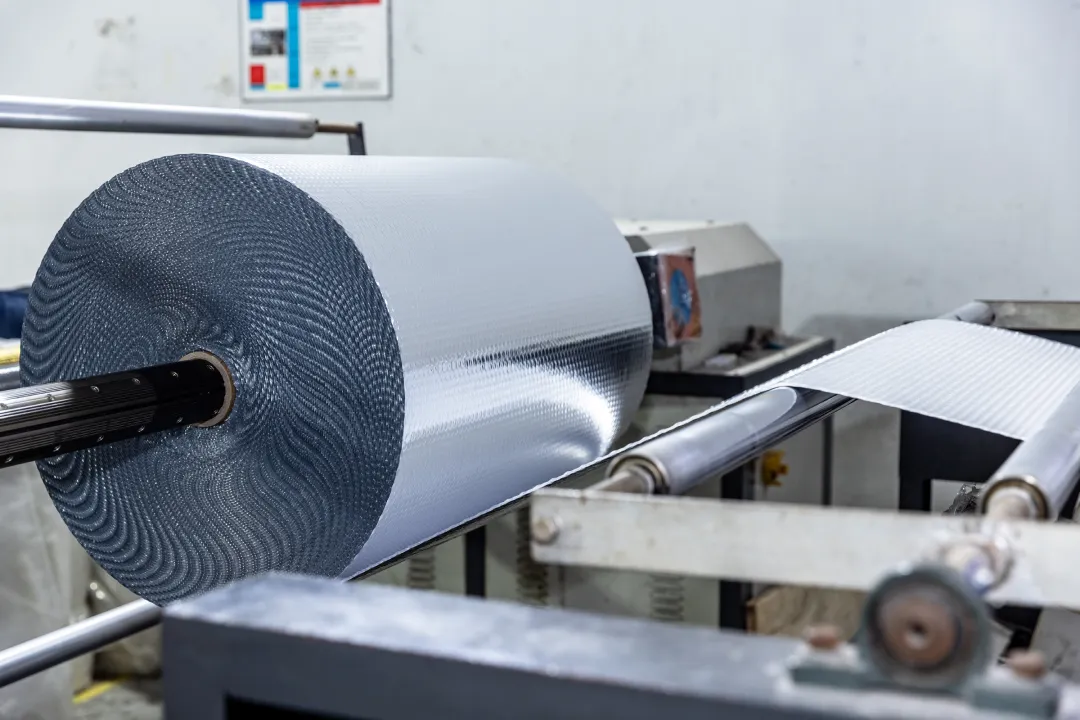
Heat control is only part of the insulation problem in metal buildings.
Condensation can become a serious concern when indoor air contains moisture and the metal roof surface becomes colder than the dew point of that air.
This situation can occur during winter, particularly in buildings with high indoor humidity, limited ventilation, or frequent temperature changes.
Moist air may move through unsealed joints and gaps in the building envelope. When it reaches a sufficiently cold metal surface, water droplets can form.
Over time, condensation may contribute to corrosion of metal components, moisture damage to insulation, and deterioration of stored materials.
Bubble foil insulation can contribute to moisture control when the product has suitable vapor-control properties and is installed as a continuous, properly sealed layer.
However, water resistance and vapor control are not interchangeable properties. A material that resists liquid water does not necessarily provide the same level of resistance to water vapor.
Nor does installing bubble foil insulation guarantee that condensation will not occur.
The result depends on the indoor humidity level, outdoor climate, roof assembly, vapor movement, joint sealing, and ventilation strategy.
For agricultural buildings, manufacturing facilities, and other high-humidity environments, condensation should be evaluated as part of the complete roof design rather than treated as a problem that one insulation product can solve on its own.
Not every metal building has the same insulation requirements.
A large distribution warehouse, for example, may have a vast roof area where installation efficiency, roll dimensions, joint sealing, and consistent material quality are important considerations.
Agricultural buildings present a different set of conditions. Indoor moisture levels may be influenced by livestock, stored crops, washing activities, and ventilation. In these environments, moisture management can be just as important as radiant heat control.
Manufacturing facilities may have continuous indoor cooling or heating requirements. Where a higher overall thermal resistance is needed, bubble foil insulation may be combined with fiberglass, mineral wool, or other bulk insulation materials.
The choice between single-bubble and double-bubble constructions should also be based on the intended application.
A thicker bubble core does not automatically guarantee better overall building performance. Reflective facing properties, air-space design, composite construction, and the thermal performance of the complete roof assembly all matter.
Material selection should begin with the building's actual requirements rather than a comparison of thickness figures alone.
Bubble foil insulation offers a practical approach to controlling heat transfer in metal buildings by bringing together two different functions: a low-emissivity reflective facing and an enclosed polyethylene bubble structure.
When correctly incorporated into a roof or wall assembly, it can help reduce radiant heat exchange while contributing additional thermal resistance. Depending on its specifications and installation, it may also form part of the building's moisture-control strategy.
Its performance, however, cannot be separated from the construction in which it is installed.
Roof geometry, air spaces, climate conditions, indoor humidity, additional insulation layers, and installation details all influence the final result.
For insulation manufacturers and material suppliers, this also means that one standard construction may not suit every metal building project.
Aluminum foil and metallized film facings, different bubble configurations, core thicknesses, and customized roll specifications can be selected according to the intended application.
The objective should not simply be to produce a thicker insulation material. It should be to develop a composite structure in which each layer serves a clear purpose within the complete building envelope.
That is what makes the difference between choosing an insulation product and designing an effective insulation solution for a metal building.
