PE coated aluminum foil vs metallized PET film: understand their structural differences, barrier properties, thermal performance and insulation applications.
At first glance,
PE Coated Aluminum Foil and PE Coated Metallized PET Film can be difficult to distinguish. Both have a silver metallic appearance, both can be laminated with foam or woven fabric, and both are widely used in reflective insulation and protective packaging products.
For buyers sourcing materials for insulation manufacturing, this similarity can create a common question: if the two materials look almost identical, can one replace the other?
The answer depends on what the finished product is expected to do.
Although both materials have a metallic surface and can serve as reflective facings, their internal structures are fundamentally different. One uses an actual aluminum foil layer, while the other relies on a thin aluminum coating deposited onto a PET film substrate.
This difference becomes important when moisture protection, mechanical durability, lamination performance, and material weight are considered.
Material Structure: Aluminum Foil vs Metallized PET
PE Coated Aluminum Foil is generally manufactured by applying a polyethylene layer to one or both sides of aluminum foil. The aluminum provides the metallic barrier layer, while PE supports heat sealing, bonding, and lamination with other materials.
Depending on the intended application, manufacturers can adjust the PE coating thickness and select single-sided or double-sided coating structures.
PE Coated Metallized PET Film has a different construction. It starts with a PET film substrate, onto which a very thin aluminum layer is deposited through a vacuum metallization process. A PE layer is then applied to meet the requirements of subsequent lamination or heat-sealing applications.
The distinction is straightforward:
- PE Coated Aluminum Foil: A continuous aluminum foil layer combined with PE.
- PE Coated Metallized PET Film: A PET film substrate with a thin deposited aluminum layer and PE coating.
Although both materials have a metallic surface, they should not be considered interchangeable without evaluating their actual performance requirements.
Thermal Performance: Reflectivity Depends on the Surface and Installation
One of the main reasons these materials are used in insulation products is their ability to reflect radiant heat.
Both aluminum foil and metallized PET can provide low-emissivity metallic surfaces. When properly installed facing an appropriate air space, these surfaces can help reduce radiant heat transfer.
However, reflective performance is not determined by the material name alone. Surface oxidation, coatings, contamination, emissivity, and installation conditions all influence how effectively a material reflects thermal radiation.
PE Coated Aluminum Foil provides a continuous metallic aluminum layer, making it a suitable option for applications that require a consistent foil-based structure.
PE Coated Metallized PET Film can also offer effective radiant heat reflection. Its performance depends on the quality, uniformity, and integrity of the deposited aluminum layer.
An important point for insulation manufacturers is that a reflective facing alone does not determine the thermal performance of an entire insulation system. Foam thickness, trapped air spaces, substrate properties, and installation methods all contribute to the final result.
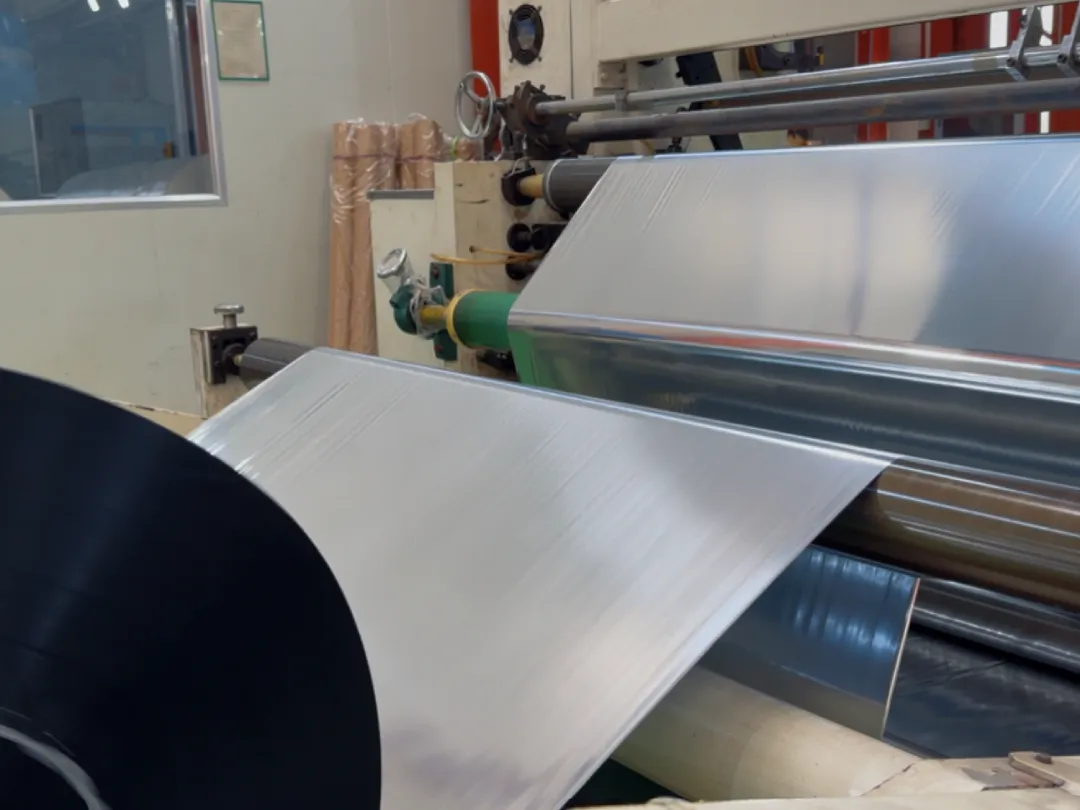
Mechanical Properties and Processing Characteristics
The two materials also behave differently during converting and lamination.
PE Coated Aluminum Foil offers the barrier characteristics of aluminum, but the foil layer can be susceptible to cracking or pinhole formation under repeated folding, sharp creasing, or mechanical stress. Once damaged, its barrier performance may be reduced.
PE Coated Metallized PET Film uses PET as its supporting substrate. PET provides good tensile strength, dimensional stability, and resistance to handling-related damage.
These characteristics make metallized PET suitable for certain converting operations, including slitting, printing, continuous lamination, and high-speed processing.
However, the deposited aluminum layer is extremely thin. Excessive abrasion, severe folding, or unsuitable processing conditions can damage the metallic coating and affect its performance.
For products that undergo repeated bending or mechanical stress, it is important to evaluate the complete laminated structure rather than considering the substrate alone.
Typical Applications of Each Material
The right choice depends on what the finished product needs to achieve.
PE Coated Aluminum Foil is commonly considered for:
- High-barrier thermal packaging materials
- Aluminum foil bubble insulation
- Reflective roof and wall insulation systems
- Industrial packaging requiring strong moisture protection
- Composite insulation materials requiring a continuous aluminum layer
PE Coated Metallized PET Film is commonly considered for:
- Lightweight reflective insulation products
- Insulated bags and protective packaging
- Laminated films requiring good tensile strength
- Applications where material weight and converting efficiency matter
- Industrial products where metallized film barrier performance meets the specification
These are general application directions rather than strict limitations. The final choice should always reflect the complete product structure, operating conditions, and required performance.
PE Coated Aluminum Foil and PE Coated Metallized PET Film may look similar, but their different metallic structures give them distinct performance characteristics. PE Coated Aluminum Foil is generally worth considering when a continuous aluminum layer and strong barrier protection are priorities. PE Coated Metallized PET Film is a practical alternative when lightweight construction, PET substrate strength, and converting performance are important.
For insulation and packaging manufacturers, the best material is not necessarily the one with the brightest metallic surface or the lowest purchase price. It is the one that delivers the required performance, works reliably with the intended substrate, and remains suitable throughout the manufacturing process. Understanding the difference between these two materials helps buyers make more informed decisions and avoid choosing a material based on appearance alone.

